Author Archives: Patricia Spencer

Jonathan Tyson – a loose end who absconded a long way

One of the things that I’ve been doing during lockdown is trying to tie up some loose ends in my family tree. My 4xGreat Uncle, Aaron Tyson (1800-1841), had three daughters and one son, but I had no information for any of them after their appearance on the 1841 census at Broughton-in-Furness, Lancashire (now in Cumbria), as Aaron had died just a few months later, aged only 41. Pursuing the lives of his children who were my first cousins, four times removed, hadn’t seemed to be a priority.

I thought I would start with Aaron’s only son, Jonathan Tyson, who was aged seven in 1841 and described as ‘born in county’. His birth was before the start of civil registration, but I found his baptism on 11 November 1833 at St Cuthbert’s, Kirkby Ireleth (Lancashire Online Parish Clerk). By the time of the 1851 census, aged 17, he was working as a farm servant, just outside Broughton. Then he disappeared; I couldn’t find him on any of the subsequent censuses, nor could I find a death for him.

So, I searched for him in the British Newspaper Archive on FindMyPast and found this:

Ulverston Mirror 30 June 1860

Jonathan Tyson was ordered to contribute 1s 6d per week towards the support of Isabella Askew’s illegitimate child. The parties lived at Broughton, but the defendant has absconded.”

If Jonathan had absconded from Broughton, then I realised I needed to widen my search area beyond the north of England, but I still couldn’t find any trace of him in UK census or death records. A worldwide search did, however, come up with a man of the right name, and age, and from England, living in Pennsylvania in 1870.

Could ‘my’ Jonathan really have absconded that far away from home to avoid paying 1s 6d a week for his illegitimate child?

The 1870 US census return shows Jonathan Tyson, 35, living with his wife Agness, 30 and also from England, and an infant son, Aaron, born the previous December. The naming of his son Aaron (Jonathan’s father’s name) suggested that this could indeed be my man. I then found on Ancestry the marriage in Liverpool on 7 September 1864, of Jonathan Tyson, son of Aaron, and Agnes Singleton, daughter of Jacob.

I also found the Pennsylvania death registration of Agnes Tyson, who died on 15 October 1908. She was described as a widow, and the daughter of Jacob Singleton and Hannah Atkinson. I now felt that I had enough evidence to say that the Jonathan who absconded from Broughton before June 1860 was the same man who was living in Pennsylvania in 1870.

If he left Broughton in early 1860 and got married in Liverpool in 1864, he was presumably still in England at the time of the 1861 census, but could have been anywhere in the country. The best option that I can find for him is a John Tyson, aged 27 (which would be the right age), from Lancashire, working as a shipwright in Tower Hamlets, London. This might not be Jonathan, but I suspect that it is. In 1861 his future wife, Agnes Singleton, a 21-year old Dressmaker, was living with her widowed mother, Hannah, in Broughton-in-Furness, but she and Jonathan must have already known each other and sometime between 1861 and 1864 they both made their way to Liverpool, where they were married in September 1864.

On the 1900 US census Agnes claims to have immigrated into the country in 1864 so the couple may have sailed from Liverpool soon after their marriage but I haven’t yet been able to find any evidence of their journey from England.

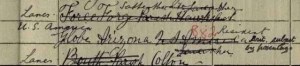
By 1870, when the census (image above) was taken, the family was living in Dartlington in Beaver County, Pennsylvania. Jonathan was described as a ‘Farm Labourer’ and Agnes as ‘Keeping House’. They had with them their son, Aaron, who was five months old, with a note that he had been born the previous December. Aaron’s place of birth was ‘Penna’ – Pennsylvania.

By the time of the 1880 census the family was registered in South Beaver Township. Jonathan was described as a Farmer while Agnes was still ‘Keeping House’, but their 11-year old son has changed his name from Aaron to William. At first I thought Jonathan and Agnes must have had two sons but the 1870 census says that Aaron was born in December 1869 and when William married he gave his date of birth as 29 December 1869. They could have been twins, but neither census has two identically-aged boys; each has only one. When he married Maggie B Gesner in 1891, and on later census records, William always gives his name as ‘William A Tyson’ so presumably he was really ‘William Aaron’.

I haven’t been able to find the exact date of Jonathan’s death but his will is available on Ancestry.
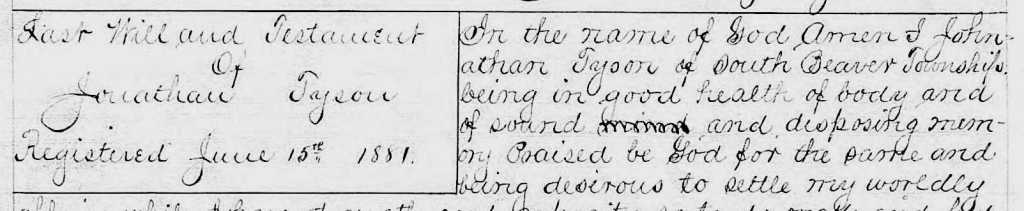
The will was written on 24 December 1880 and leaves his land, livestock and ‘implements of farming purposes’ to his son, William and his household goods, furniture and ‘all of my money in Bonds, mortgages or money at interest’ to his wife, Agnes. The will was sent for probate on 15 June 1881, so Jonathan must have died between 24 December 1880 and that date. He was only 47.

Most of the schedules of the 1890 US census were destroyed by fire in 1921, and Pennsylvania is not one of the states for which records survive. By the time of the next census in 1900 William, his wife and five children were still living in Beaver Township, as was Agnes, though her entry on the record is curious as she is living six households away with William and Mary Waggle but is described as ‘mother to family 9 above’. She was a ‘widow’ and ‘Housekeeper’.

Agnes died, aged 69, eight years later, on 15 October 1908. Her occupation on the death certificate was given as ‘Decrepit’ and the cause of death ‘General Debility. Gradually Failed’. She was buried two days later in the local Seceder United Presbyterian Cemetery.

I always wonder how much people like Jonathan and Agnes kept in touch with family and friends back in England. It would seem unlikely that Jonathan would have had any direct contact with Isabella Askew and the child she bore; the cause of his original abrupt departure from Broughton-in-Furness, but perhaps he heard from others that his daughter was baptised Elizabeth on 1 July 1860. She and her mother, Isabella, were living with Isabella’s parents at the time of the 1861 census, and Elizabeth stayed with her grandparents after her mother married William Herbert on 5 December 1863. Theirs was a short marriage, marred by many deaths. They had five children between 1864 and 1874 but only their youngest son, Thomas, lived to grow up; the others all died before the age of six. In 1875 William died, leaving Isabella a widow at the age of 41 and with two sons, then aged four and one, to bring up alone. Only four years later Elizabeth Askew, the daughter of Isabella and Jonathan Tyson, died, aged only 19, and was buried on 18 September 1979. Her mother, Isabella, died, aged 45, two months later and was buried on 3 November 1879.

One final thought: when I was trying to identify records for Jonathan in Pennsylvania, it took some time as there was another Jonathan Tyson living in the same area and about the same age, so I had to look at his records to sort out which Jonathan was which. I also came across another Aaron Tyson. Both Christian names occur regularly in this one of my Tyson lines (Tyson is a very common surname in Cumberland and the Furness area). It made me wonder if someone else from Jonathan’s family had emigrated to Pennsylvania, maybe a generation or two earlier, and if that was why Jonathan and Agnes had settled there. Something else to investigate!
Two contrasting memorials in Salisbury Cathedral

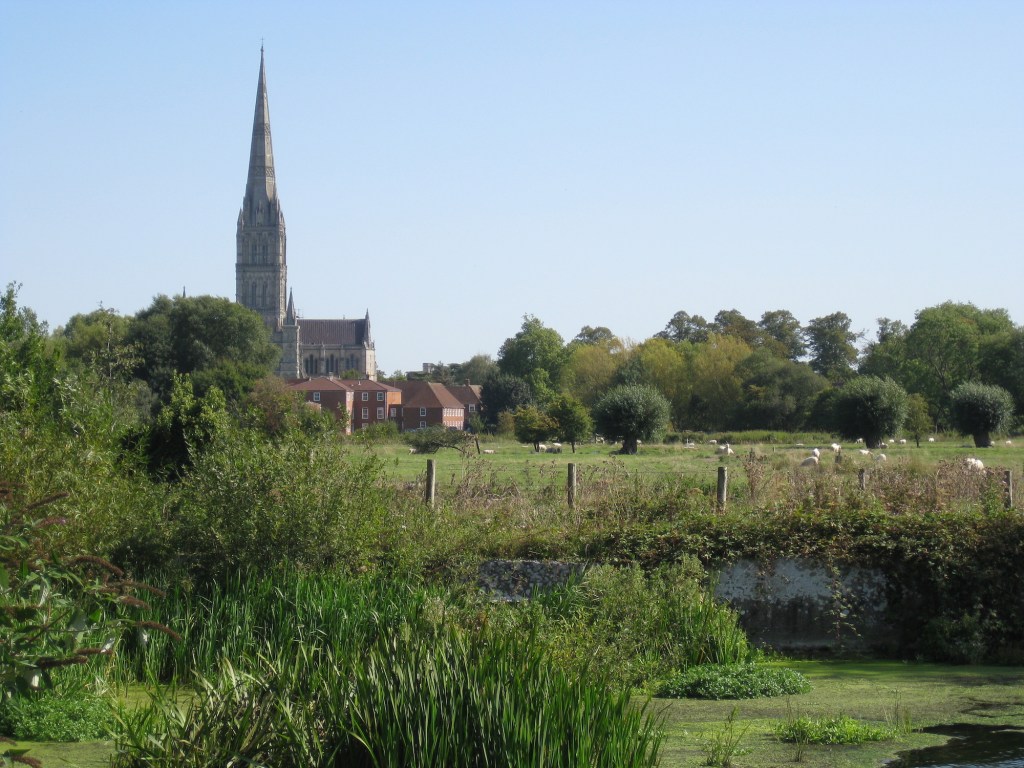
Last weekend, on what was almost certainly going to be the last warm and sunny day of the summer, I visited Salisbury for the first time and, inevitably, homed in on the magnificent Cathedral.

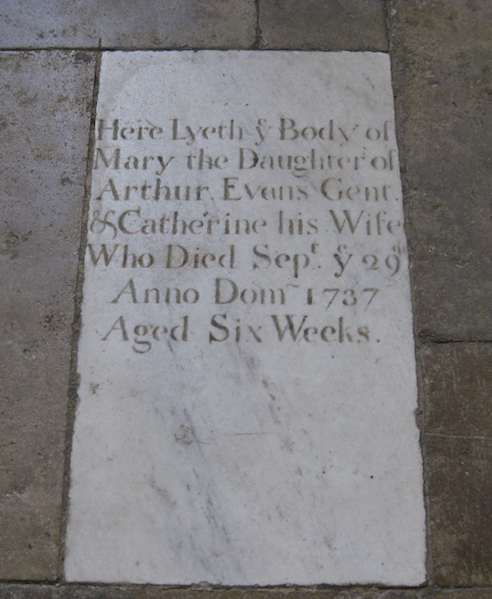
Although I have no family links at all to Wiltshire (at least, so far as I yet know), in the midst of all the impressive tombs of ‘the great and the good’, a very modest floor-slab caught my eye.

“Here Lyeth ye Body of Mary the Daughter of Arthur Evans Gent. & Catherine his Wife Who Died Sept. ye 29th Anno Dom~ 1737 Aged Six Weeks.”

I haven’t been able to find online a baptism for Mary but her burial on 1 October 1737 is on FindMyPast, in the series ‘Wiltshire Burials Index’ recorded by the Wiltshire FHS. Wondering why a very short-lived child was given the honour of burial in the Cathedral, I investigated further and was able to find the marriage of her parents (again thanks to the recording done by Wiltshire FHS and by the Wiltshire OPC) on the 6 November 1731 at Hinton Parva (also known as Little Hinton), about 40 miles north of Salisbury. Arthur Evans was from the parish of Rodborne Cheney and his bride, Catherine Coker, is described as being the daughter of the Officiating Minister, Thomas Coker.

Thomas Coker was Rector of St. Swithun’s Church, Hinton Parva, Wiltshire, from 1684-1741. His patron had been Gilbert Burnet, Bishop of Salisbury from 1689 to 1715. Although his patron was no longer Bishop by the time Mary died, Thomas’s own high-standing amongst the local clergy must surely have been the reason why his baby granddaughter was granted a burial within the Cathedral.

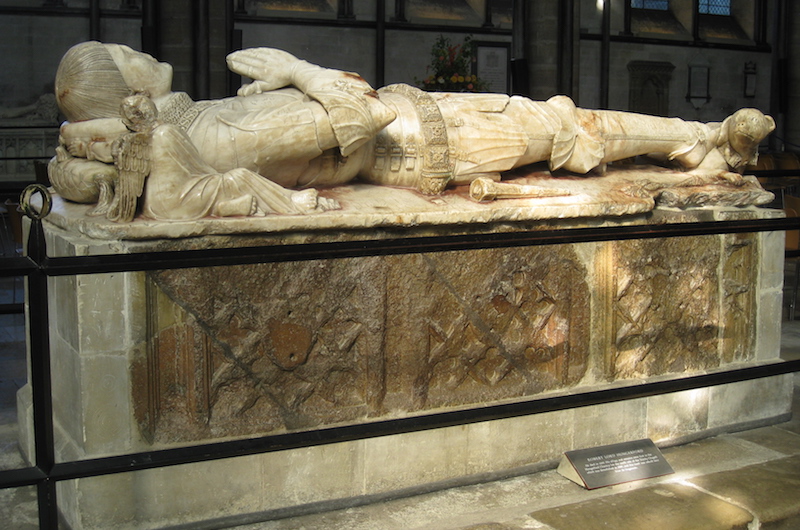
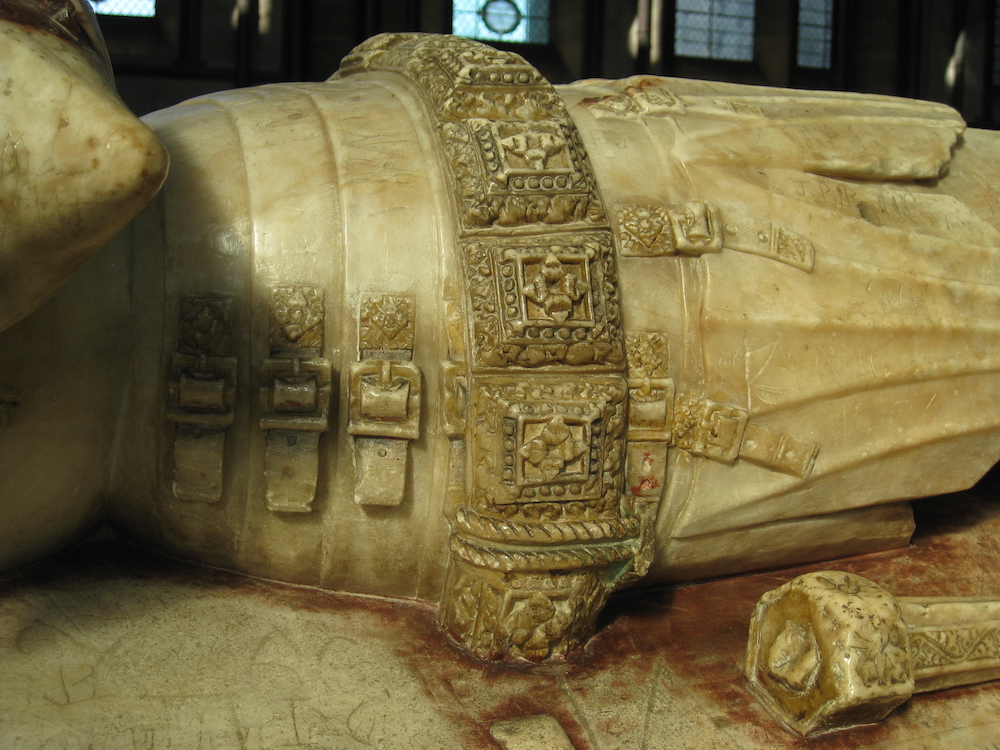
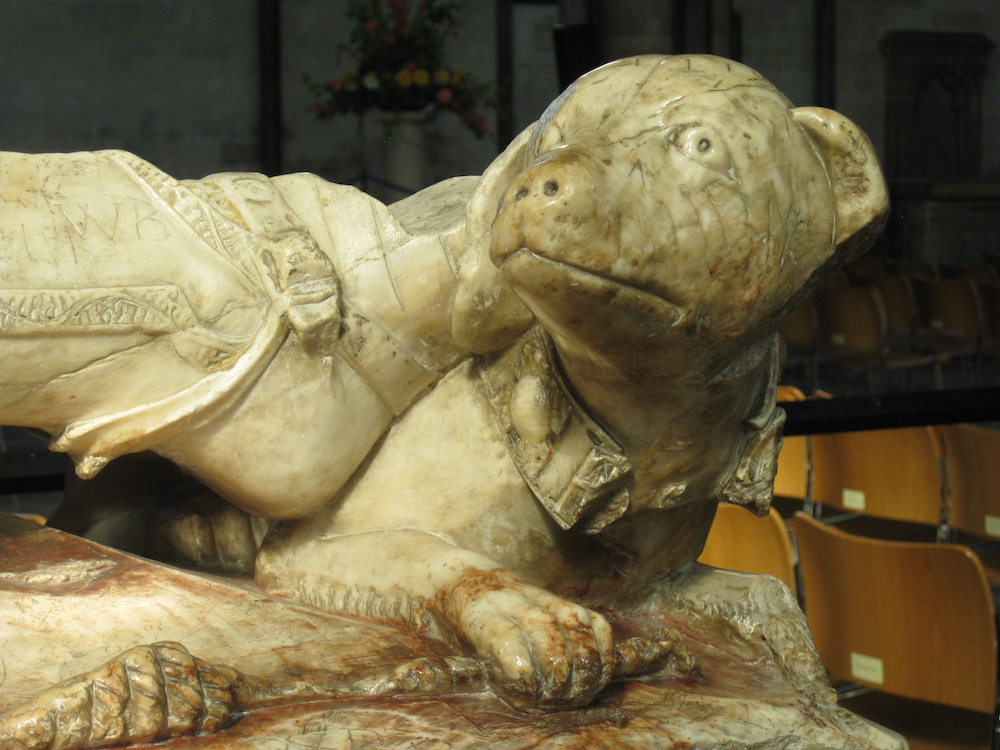
In contrast to baby Mary’s stone memorial, one of the many impressive tombs in the Cathedral that I found particularly attractive is that of Robert, 2nd Lord Hungerford (1409-1459) who served in the Hundred Years War. He has the pudding-basin haircut fashionable at the time and the details of the buckles and decoration on his robes are very fine. I particularly like the little dog on which Robert’s feet gently rest for eternity.

Great Aunt Emily

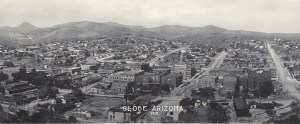
When the 1911 census was released and I was checking on the whereabouts of family that I had already found in 1901, I was somewhat taken aback by the place of birth given for a son of my Great Aunt Emily Byrne (née Park). At the time Emily, although married, was living with her parents, Edward Park and Sarah Eleanor (née Cole), at Bouth, Haverthwaite, Lancashire (now in Cumbria). Emily’s husband, James, a miner, was not with the family and was lodging in Egremont, Cumberland, where he had presumably found work. Emily’s two sons were living with her and their grandparents and the elder, Edward James Byrene, aged three, was described as having been born in: ‘US America, Globe Arizona’. His nationality was given as ‘Resident. British Subject by parentage’.

This seemed very unlikely for a family that had been firmly rooted in the south Cumberland/Furness area for centuries and clearly needed further investigation!

The only thing that our mother had told us about her Aunt Emily was that she had been ‘killed on the railway’ – a fate which appeared to have befallen several of my mother’s relations and which we took with a large pinch of salt. Emily’s life, however, shows that unexpected things such as emigrating to the USA and then returning to England, or being run over by a train, could, and did, happen to ordinary people.

Emily was born on 27 November 1876 at Force Forge and baptised on 17 December at Satterthwaite. She started at Bouth British School in Colton on 3 March 1883 when she was aged five years and four months (School Admission Register, Bouth British School, Colton, accessed on FmP) but by 1887 she was at Colton School and features in several entries in the School’s Log Book (Cumbria Archive Barrow-in-Furness: BPS 68/1/1). School log-books usually only mention children by name when they misbehave, miss school for any reason, or leave. Emily would seem not to have been a very robust child and it was her ill-health which caused her name to appear several times in the log-book.

4 March 1887:  ‘I gave all the children in Standard iii an examination yesterday when all did their work very creditably, with the exception of Emily Park [aged 11], who is partly to be excused as she is delicate, being subject to violent Headaches and earaches.’

19 April 1887: ‘Emily Park is away from school almost half her time with sickness and consequently cannot keep pace with the others, in fact her parents have forbidden her being pressed forward.’

16 May 1887: ‘Emily Park returned to school this afternoon, but I have been compelled to ask her parents to get medical advice as to her fitness to attend as she has not yet recovered from a very infectious disease viz. the ‘Itch’.’

13 June 1887: Three children had been absent for a long time, the doctor ‘has given orders that they will not be able to attend for some time to come and will certify to that effect if requested. The three are [names given] and Emily Park, St. iii – The feet of Emily Park has [sic] now broken out with the same disease as her hands’.

Emily’s school days did not last much longer as on the 1891 census, when she was 14 years old, she is living with her family and described as a ‘General Servant. Domestic’. By 1901 (aged 24) she had joined her father at the Blackbeck Gunpowder Works where she was employed as a ‘Cartridge Wrapper’.

On 4 February 1905 she married James Byrne at Our Lady’s Catholic Church in Dalton-in-Furness. James, whose birthplace is given variously as ‘Ireland’ and ‘Dalton in Furness’ on census records, was the son of Daniel Byrne and Ellen Ryan who were married in Rathdrum, Co. Wicklow on 2 November 1877. However, by 1881, the family had moved to England and were living at Cleator Moor in Cumberland, where Daniel worked as a miner.

Only seven months after Emily and James were married, on 9 September 1905, he sailed from Liverpool aboard the SS Campania. He is described in the ship’s manifest as being 25, married and a miner. He paid his own passage and had $50 with him. His nationality is given as English with his last place of residence ‘Dalton in Furness’ and he was going to join his (younger) brother Patrick Byrne in Bisbee, Arizona. The Campania arrived in New York on 15 September.

Emily followed her husband nine months later on the same ship, sailing from Liverpool on 9 June 1906 and arriving in New York on 17 June. On the ship’s manifest, she is described as being 29 and going out to join her husband, who had paid for her passage, in Bisbee, Arizona, She had $20 in cash.

Bisbee, Arizona (situated just eight miles north of the border with Mexico), was, in the early decades of the twentieth century, a boom-town with rich mineral mines, and a large immigrant labour-force, which Patrick Byrne and James had, presumably, joined.

It is hard to imagine Emily’s thoughts as she set off from the Furness area to make such a long journey. Did any of her family – her father, Edward, perhaps, or her brother (our Grandfather) Walter travel with her, probably by train, as far as Liverpool? The SS Campania on which both she and James traveled separately, belonged to the Cunard Steamship Line and, when she entered service in 1892 became the largest and fastest passenger ship, capable of crossing the Atlantic in less than six days. Her first-class accommodation was luxurious, but the passenger manifest shows that Emily was travelling ‘2nd Cabin’ which would have been much more basic. Once she had arrived in New York and had been processed through Ellis Island, she would have then had to make the 2,367 mile long train journey to Bisbee. I would like to think that James went to New York to meet her, as the journey would have taken several days and involved changing trains from one railway company to another – a daunting experience for a young woman travelling alone and so far from home.

Emily gave birth to their first child, Edward James, in Globe, Arizona some time in 1907, so James and Emily must have travelled, probably in search of work, the 216 miles from Bisbee to Globe, which had been founded in 1875 when silver was discovered in the area. By the early twentieth century some of the world’s richest copper deposits were being mined there and Globe was becoming a large and prosperous town.

Despite what must have been potentially bright prospects in Globe, Emily returned to England in 1909, arriving back at Liverpool on 30 January with her infant son, but without her husband, who presumably stayed on, for at least a while, in Arizona. Emily gave birth to their second son, William Daniel on 4 October 1909, so perhaps, having given birth once abroad, she decided to return home before she had another child. Emily went back to live with her parents in Haverthwaite and it was there that I found her with her two sons on the 1911 census. Sadly, Arizona-born Edward James died only a few months later, aged four, and was buried on 13 September 1911 at St Anne’s Church, Thwaites.

The couple’s third child, Ellen Sarah, was born on 26 July 1912, followed by Catherine Elizabeth, born on 30 September 1916. When the 1939 Register was compiled, James, Emily and Catherine were living at 4 Holmes Green, Dalton-in-Furness. James, by then 61 years old, was still working as an ‘Iron Rock Miner’, Emily was 62 and was ascribed the usual ‘Unpaid Domestic Duties’ of a housewife, while Catherine was 23, single, and employed as a Domestic Servant. By that time, despite the outbreak of the Second World War, Emily and James could probably reasonably have expected to live in relative peace into old age, but Emily was to die tragically only a year later.

On Saturday 7 September 1940 Emily and her daughter, Catherine, were returning home to Dalton from Carlisle, and they arrived at 10.15pm at Carnforth, where they needed to change trains. What happened next was described in the Lancashire Daily Post on 9 September 1940:

UNCONSCIOUS WOMAN RUN OVER AT CARNFORTH

A black-out tragedy has taken place at Carnforth railway station, the victim being Mrs. Emily Byrns (63) of 4 Holmes Green, Dalton-in-Furness. Mrs Byrns was removed to the Royal Lancaster Infirmary on Saturday night, and died early yesterday morning. She and her daughter Katherine arrived at Carnforth station from Carlisle at 10.15pm. They made their way to the Dalton departure platform. Then the daughter missed her mother in the darkness. Unable to discover her whereabouts the daughter sought the assistance of the station staff and about 11 o’clock Mrs. Byrns was found lying on the permanent way between the platform and the main line. Her right leg had been severed below the knee, her left foot badly crushed, and there were other injuries.

SLIPPED OFF THE PLATFORM. Between the time when Miss Byrns missed her mother and the discovery of her on the line a light engine and good train passed over that section. It is presumed that Mrs. Byrns slipped off the edge of the platform and was rendered unconscious by the fall. Miss Byrns was also removed to the Infirmary for treatment for severe shock.

On 11 September, the same newspaper carried a report on the inquest, :

Daughter’s Ordeal at Carnforth

A DALTON-IN-FURNESS young woman’s ordeal on Carnforth station on Saturday night, when she found her mother injured on the line, was described, at the inquest at Lancaster, to-day, on Emily Byrne (63) of Holmes Green, Dalton-in-Furness, who died in the Royal Lancaster Infirmary on Sunday. Catherine Elisabeth Byrne said she and her mother arrived at Carnforth station on their way from Carlisle about 10 o’clock on Saturday night. Their connection was not due for about an hour, and they went into the waiting-room. After a while her mother got up, saying she was going to see about the time of the train, and as she was away a long time witness went to look for her. Along with a porter she looked into the carriages of the Barrow train which had come in, but failed to find her, and they ultimately discovered her lying injured on the railway line.

PORTER FOUND BODY. James Parker Smith, of Rose Cottage, Priest Hutton, a porter, said he had found Mrs. Byrne on the main down line, and Sidney Powell Booth, of New-street, Carnforth, a foreman, said medical attention was given by a doctor on the permanent way and in the waiting room before she was taken to the infirmary. Witness said a goods train and a light engine had passed over the line, but he could not say which had run over the woman. A doctor’s certificate described Mrs. Byrne’s injuries, including the amputation of the right foot. The Deputy Coroner (Mr. J. H. Jellyman) returned a verdict of “Accidental death” and on behalf of the railway company Mr. O. T. Tewson expressed sympathy with the relatives.

Emily’s husband, James, survived her by 15 years, dying in 1955. Their daughter Catherine, who had been with her mother on Carnforth station, married Charles Hay in 1941 but was widowed only three years later, as reported in the Lancashire Evening Post on 4 August 1944:

Mrs. Hay, of 4 Holmes Green, Dalton-in-Furness, has been notified that her husband, Lance-Cpl. Charles Robert Hay, has died of wounds in Normandy. He was 31 years of age, and a painter and decorator by trade.

Charles’ service record shows that he had died on 7 July 1944. The widowed Catherine married Roy Whitter in 1954, and died in 1988.

After all Emily’s travels – by train from a small Furness village to Liverpool, crossing the Atlantic alone, making the long train journey to Arizona and then retracing the same route, with her infant son, just a few years later – it seems sadly ironic that she should have died in an avoidable railway accident so close to her family home.

A surfeit of oatcakes

When I first started looking for traces of my ancestors in newspaper reports, I wasn’t too optimistic that I would find anything useful or interesting, since, so far as I knew, none of them had been rich or famous or done anything that would be worth a mention in print. I couldn’t have been more wrong! News reports have turned out to be of immense value to my family history research, adding meat to the bare bones of births, marriages, deaths and census returns, while giving me a much better idea of the lives that my ancestors lived and (in several cases) the crimes they committed. From the details given in ‘personal announcement’ columns, I have been able to confirm relationships and break down some of my brick walls.

One newspaper report which gave me particular pleasure concerned one of my 4xGreat Grandmothers, Dorothy Tyson. It appeared in the Whitehaven Pacquet on Tuesday 30 July 1839 (original punctuation retained):

It seldom happens that when either man or woman attains the great age of 76 years that they are able to endure the labour which in early life they would have looked upon with unconcern. The fact however we are about to mention not merely forms an exception to this nearly general position, but shows a degree of activity and hale old age not often to be met with. Mrs. Dorothy Tyson, of Wallend, near Broughton in Furness, mother of Mr. Tyson, of the King’s Head inn, in that town, who within the past week, although in the 76th year of her age, kneaded, rolled, and baked sixteen stones of oatmeal in fourteen successive hours! and not, let us observe, after the fashion of the Scotch, in thick bannocks, but in the custom of the district, in cakes not much thicker than a wafer.”

Unfortunately the report doesn’t tell us why Dorothy was making so many oatmeal cakes – perhaps for use at her son’s inn?

Dorothy (née Bell) from St Bees, Cumberland, had married Richard Tyson on 16 May 1796 at St James’s Church, Whitehaven. Richard was originally from Millom but in 1813 he leased the Wallend farm, including fields, stock and sheep, at Broughton-in-Furness, for an initial term of seven years. The lease must have been renewed several times as the Tysons lived there until at least 1861, but by the time of the 1871 census, a different family was in residence.

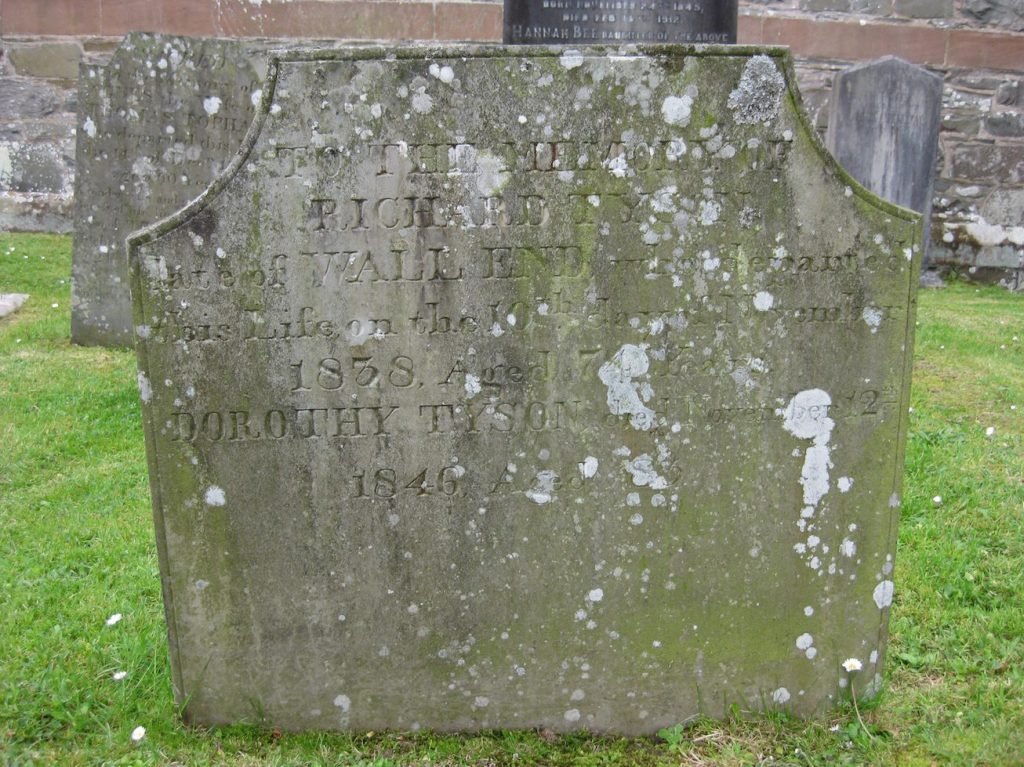
Richard Tyson died on 10 November 1838 and Dorothy eight years later on 12 November 1846. The running of Wallend farm was taken over (until at least 1861) by their sixth son, Jonathan, as two of his five older brothers farmed elsewhere, while another two became innkeepers and one had died as an infant. Both Richard and Dorothy were buried at St Mary Magdalene’s Church, Broughton-in-Furness, where, unlike most of my ancestors, they are commemorated on a headstone.

Gravestone of Richard and Dorothy Tyson at Broughton-in-Furness

Explosion at Blackbeck gunpowder mill

It is quite possible that few visitors to the Lake District today, admiring the impressive and beautiful rural landscape, appreciate quite how ‘industrial’ the area was in previous centuries, with quarries, mines and mills, as well as farms, providing work and income for both local inhabitants and men who moved to the area from as far afield as Cornwall and Ireland.

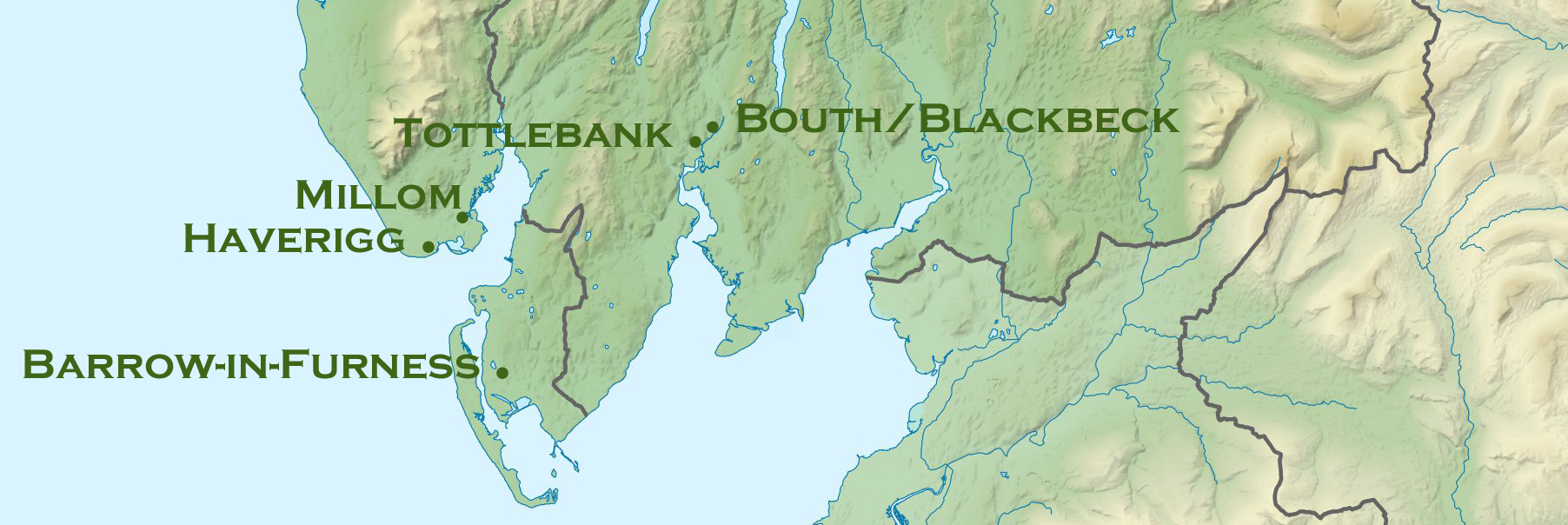
Working in these industries was usually hard and could be dangerous, with many accidents and deaths recorded. One of the most notorious workplaces was the Blackbeck Gunpowder Mill, where production started in 1862. It was located near the village of Bouth on the Furness peninsula, which was in Lancashire until 1974, but is now in Cumbria.

https://commons.wikimedia.org/wiki/File:Cumbria_UK_relief_location_map.jpg. Contains Ordnance Survey data © Crown copyright and database right [CC BY-SA 3.0 (https://creativecommons.org/licenses/by-sa/3.0)%5D, with added place-names.

Several members of my family worked at the Blackbeck mill and in 1906 an explosion there killed the first husband of my Great Aunt Alice.

Walter Bell was born in 1883, the son of Stephen Bell, a mason/waller and his wife Mary (née Taylor). At the time of the 1891 census Walter was only seven years old and a ‘scholar’ but four of his sisters, aged 14-21, were all employed as ‘powder packers’, almost certainly at Blackbeck, which was a major employer in the area. By the time of the 1901 census Walter, then aged 17, was working as a ‘gunpowder labourer’. His future wife, Alice Taylor Park, was only 13 in 1901 and at school, but one of her sisters, Emily, aged 24, was a ‘Cartridge wrapper, Gunpowder works’ and their father (my Great Grandfather) Edward Park was described as ‘Wood Boxmaker, Gunpowder works’. Edward was to be employed at Blackbeck until the mill closed in 1928.

The Park family at Bouth in 1901
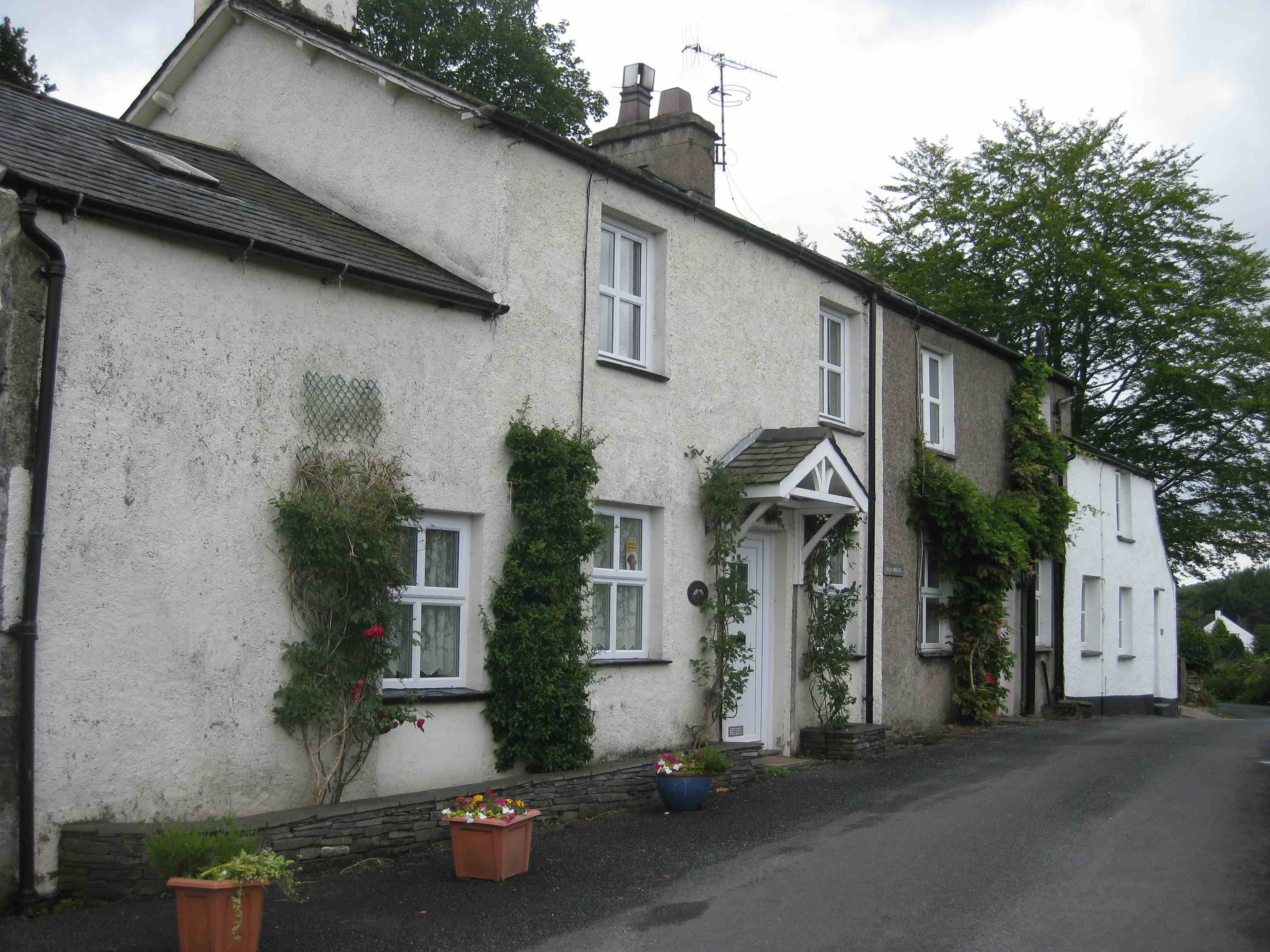
Kiln Cottages in Bouth where the Park family were living in 1901

Walter Bell and Alice Taylor Park were married in the third quarter of 1904 and their only child, Edward Stephen Bell, was born on 27 July 1905. On 30 April 1906, Walter set off for work from the family’s home in Bouth. According to the North Lonsdale Herald of 5 May 1906:

Bell, it appears, was the owner of a very intelligent dog. On the morning of the sad occurrence the deceased was playing with the dog and when he got up from his chair to go to work, the dog held him by the trousers with its teeth, dragging him back towards the chair. On two occasions after this the dog repeated the performance and it is stated that this strange behaviour on the part of the dog led Mrs Bell to remark that it did not appear to want her husband to go to work.’

About 10.50 a.m. the countryside resounded with the report of a deafening explosion … the corning house was a complete wreck and the two occupants lay mutilated and lifeless. The two men killed are John Woodburn, aged 51, who was in charge of the corning house, and Walter Bell, aged 22. Both were married men. … The explosion is rendered additionally sad by the fact that Bell is practically a newly married man.  … the two poor men were hurled over a wall about 30 feet high. Bell, it is thought, caught the top of the wall when falling, and his body was shockingly mutilated in consequence. Woodburn’s body was picked up about 40 yards from the wrecked building in which he had been working, and Bell’s was about 25 yards away. The clothing of the man Bell was on fire when his body was found, and he is said to have been breathing slightly. Woodburn was quite dead. … Bell had only been married a little over 12 months, and he leaves a widow and one child.

The bodies of the two deceased workmen were interred on Wednesday after the funeral of John Woodburn taking place at Colton Parish Church, and that of Walter Bell at Tottlebank Baptist Chapel, the former being fixed for 2 o’clock and the latter for 3.30 pm. The works were closed, and consequently the whole of the workmen, together with many from the surrounding villages, were present. The services were very impressive, and sympathy to the bereaved ones was manifested on all sides.

Walter’s widow, my Great Aunt Alice, who was only 19 when she was widowed, married Arthur Atkinson in 1909 and they had four children. The 1911 census shows that Arthur was also then working at the gunpowder mill, though by the time of the 1939 Register he was driving an electric crane at the shipyard in Barrow-in-Furness. Alice died in 1950 aged 63.

I was unable to find a headstone for Walter Bell in the churchyard of Tottlebank Baptist Chapel, where Walter’s funeral took place. The Church is a Grade II Iisted building which dates back to 1697 (according to their website) or c.1750 (according to Historic England). From the outside it is an unprepossessing roughcast single storey building but it is in a lovely, peaceful place, with views over the surrounding countryside.

Tottlebank Baptist Chapel
View from the graveyard of Tottlebank Baptist Chapel

The site of the Blackbeck Gunpowder Mill, also in a beautiful location, is now a caravan park with nothing to show that it was once a busy, noisy and dangerous place where many worked, and where, in the course of its existence, 66 men, including my Great Uncle, Walter Bell, died.

Thomas Mawson

When people first start looking into their family history, they are nearly always advised to begin by gathering together any documents or photographs already in the family’s possession and by asking questions of older family members. By the time I started researching my family history, there were few older family members still alive, and talking to those who were often raised more questions than were answered!

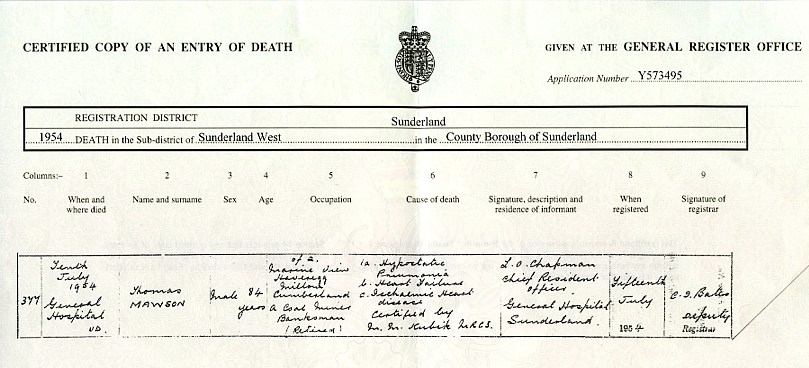
It proved impossible, for example, to establish exactly when my Great Grandfather, Thomas Mawson, had died. My mother and her cousin both thought it had been in the early 1950s but couldn’t pin it down more accurately. I was then (2004) working in central London and the Public Records Office was a short walk away in Myddelton Street, so I spent several lunch hours there, trawling through the large, heavy registers, trying to find the death of a Thomas Mawson in the late 40s/early 50s in or close to Millom in Cumberland, but with no success. The only death registration for a Thomas Mawson of approximately the right age who had died in the relevant period was in the September quarter of 1954 in Sunderland. Neither my mother nor her cousin could think of any reason why he would have died on the opposite side of the country so I was fairly sure that this wasn’t the right man.

However, not knowing when he died continued to niggle at me, so in June 2005 I finally ordered a copy of the death certificate for the man whose death was registered in Sunderland, mainly to rule him out, only to find that this was indeed my Great Grandfather, who had died on 10 June 1954, aged 84, in Sunderland General Hospital.

The certificate includes his home address ‘2 Marine View, Haverigg, Millom, Cumberland’ confirming that this is the right man, but I suspect I shall never know why he died in a hospital so far from home. His body was returned to Cumberland for burial at Holy Trinity Church in Millom, alongside his wife, Betsy, who had died in 1944.

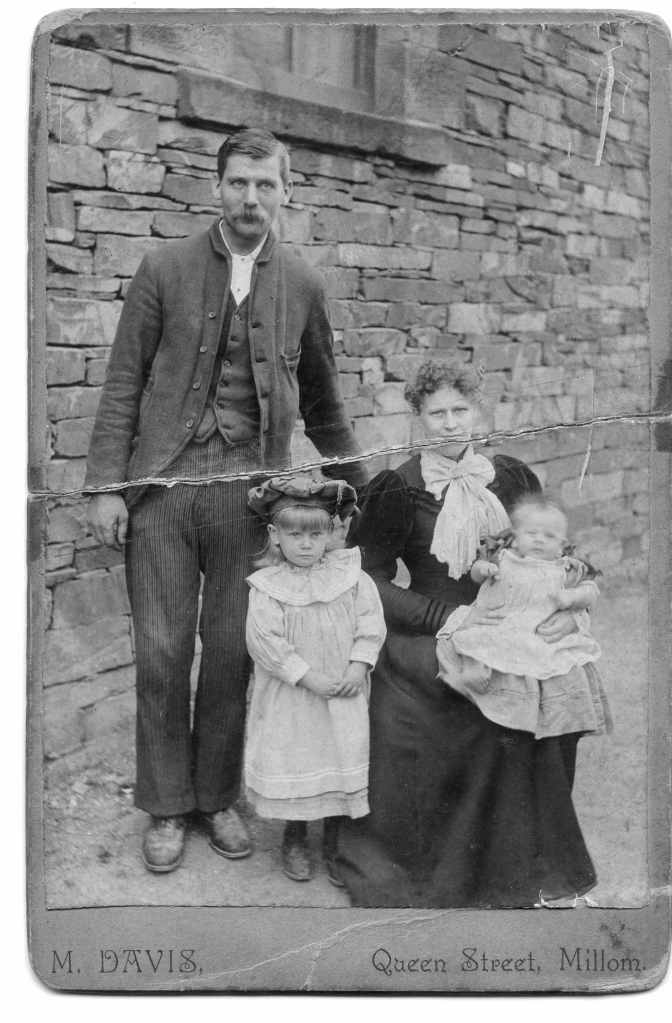
My family did not preserve many old photographs but I do have one of Thomas taken in 1899 when he was 30. He is shown with Betsy (née Willan) and their daughters Elizabeth Annie (my grandmother, then aged four) and Bessie (a few months old).

Thomas and Betsy had had another daughter, Mary, who had been born on 8 August 1891 and died on 8 June 1895, aged only three. She was, apparently, always a frail child and Thomas made a small rocking chair for her which was still in the family when I was a child. I spent a wet Cumbrian afternoon, when I was a teenager, in the graveyard at Holy Trinity Church in Millom looking for Mary’s grave – probably the first time I showed any interest in family history. When I returned home, dripping wet and unsuccessful, my mother pointed out that the family wouldn’t have been able to have afforded a headstone for Mary. The grave of Thomas and Betsy is not marked either so I don’t know exactly where they are buried, though the same is true for most of my Cumbrian ancestors and members of their families. When I was last in Millom, I visited the local funeral directors, Sheldon (Funeral Services) Ltd, where staff members were very helpful and kindly looked up and copied for me their invoice from 1954, showing that the cost of Thomas’s funeral was £18 6s. Unfortunately they weren’t able to help me to locate his and Betsy’s grave, although they had previously been able to identify the location of my Grandfather’s unmarked grave, but that’s another story!

Where to begin?

I’ve been researching my family history for around 15 years and during that time have amassed a lot of information and interesting stories; not only about my own ancestors and the places where they were living and working, but also about some people and places that are totally unconnected to me.

What to do next with masses of collected information concerns me, as it does many family historians, so I decided to start writing this blog and see what develops.

Family history is never-ending so some of the stories here may be complete in themselves while others are very much ‘work in progress’ and I would welcome comments and feedback.

Now I just need to decide where to begin….